

Relaxed fit activewear is clothing cut with intentional extra ease through the chest, waist, and hips, engineered for movement rather than muscle compression. It’s the right choice for low-to-medium intensity activity, travel, errands, and any time you need your outfit to carry you from the gym straight into real life. Research on sportswear fit types confirms it’s the go-to cut for yoga, Pilates, casual training, and gym-to-street wear. Kyndeoactivewear builds its collections around exactly this principle.
Table of Contents
- What does “relaxed fit” actually mean in activewear?
- When should you wear relaxed-fit workout clothes?
- Benefits and trade-offs of relaxed fit vs. fitted activewear
- What fabrics and construction details should you look for?
- How do you pick the right relaxed-fit piece?
- How to style relaxed-fit activewear for gym-to-street looks
- How to care for relaxed-fit activewear
- Kyndeoactivewear brings relaxed-fit design to everyday movement
- Key Takeaways
- Why relaxed fit deserves a permanent spot in your rotation
- Useful sources
- FAQ
What does “relaxed fit” actually mean in activewear?
Relaxed fit is not just a larger size. It’s pattern-drafted with extra ease placed in targeted areas, specifically the chest, waist, and hips, while the shoulder seam stays aligned with your actual shoulder. That last detail matters. When you size up instead of buying a true relaxed cut, the shoulder seam droops past the joint and the sleeves run too long. That’s a sizing error, not a fit choice.
Visual cues of a true relaxed fit:
- Dropped or slightly lowered shoulder seam (intentional, not drooping)
- Boxier silhouette through the torso
- Non-tapered hem, often curved or straight-cut
- Room through the hips without excess fabric pooling at the waist
Industry guides describe it as the “Goldilocks” cut: intentionally roomy but engineered for movement, not simply oversized.
| Fit Type | Silhouette | Airflow | Compression | Best Activity |
|---|---|---|---|---|
| Relaxed | Boxy, extra ease | High | Low | Yoga, errands, gym-to-street |
| Regular/Athletic | Follows body contours | Moderate | Moderate | General training, casual sport |
| Compression | Body-hugging | Low | High | Running, heavy lifting, HIIT |
When should you wear relaxed-fit workout clothes?
Relaxed-fit pieces are built for low-to-medium intensity movement, travel, errands, yoga, Pilates, casual training, and gym-to-street transitions. That covers a lot of ground, which is exactly the point.
For yoga and Pilates, the extra ease lets you move through full ranges of motion without fabric pulling across the back or hips. For travel and errands, the relaxed silhouette reads as casual streetwear while still being built from performance fabrics. For gym-to-street, structured design details like curved hems and ribbed necklines keep the look polished when you walk out the door.
Do / Don’t guidance by intensity:
- Do wear relaxed fit for yoga, stretching, Pilates, light cardio, walking, and casual gym sessions
- Do layer a relaxed hoodie or tee over compression gear for warm-ups and cool-downs
- Don’t rely on relaxed fit alone for high-intensity running or heavy compound lifts, where muscle support matters
- Don’t assume relaxed means low-performance. With the right fabric, it handles medium-impact work well
Compression wear earns its place for high-intensity sessions. Relaxed fit earns everything else.
Benefits and trade-offs of relaxed fit vs. fitted activewear
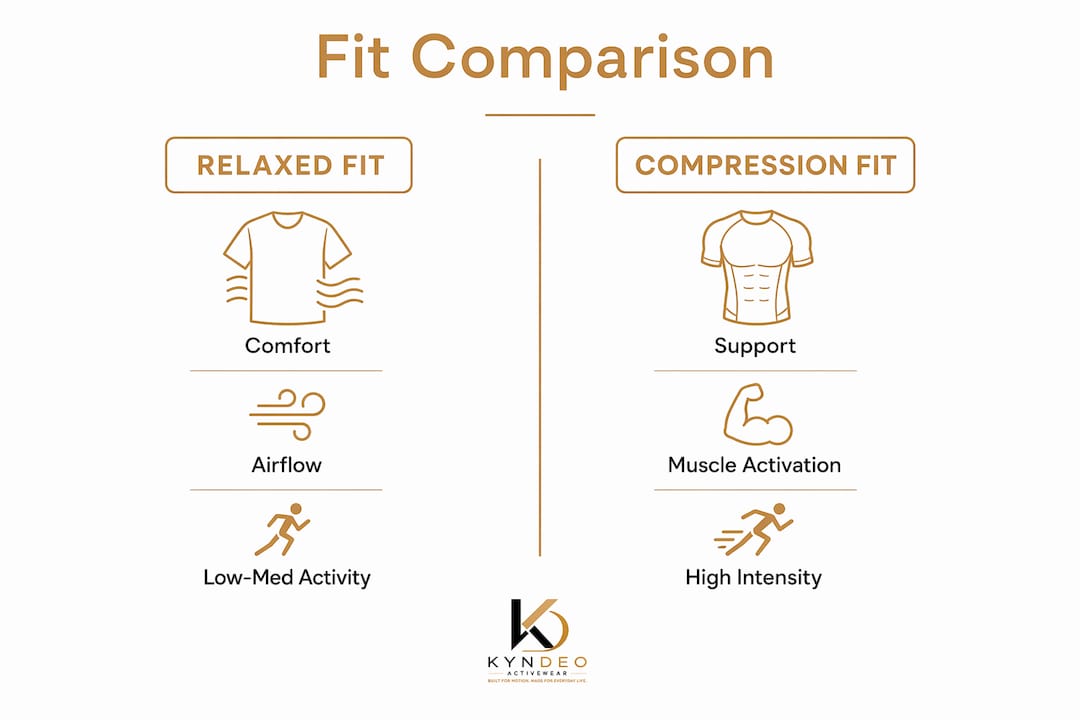
The core case for relaxed fit comes down to three things: comfort, breathability, and mobility. Sports-science research shows loose-fitted clothing improves heat dissipation and thermal comfort during exercise by increasing air permeability and airflow across the skin compared to tight-fitting garments.
Pros:
- Greater airflow and thermal comfort during moderate activity
- Unrestricted range of motion through shoulders, hips, and torso
- Easier to layer over base layers or under outerwear
- Transitions naturally from workout to street without changing
Trade-offs:
- Less muscle compression and support for high-impact activity
- More fabric movement during fast or explosive movements
- Can look unstructured without intentional styling choices
The choice between tight and loose clothing balances physical support against thermal comfort. Tight clothing can reduce muscle oscillation during high-impact effort, while loose clothing improves airflow and helps prevent overheating. For moderate activity and everyday wear, the thermal advantage of a relaxed fit often outweighs the compression benefit. — PMC Thermoregulation Review
When technical fabrics like moisture-wicking four-way stretch are used in a relaxed cut, the performance gap narrows considerably. The fit stays comfortable; the fabric does the work.
What fabrics and construction details should you look for?
A relaxed silhouette only performs if the fabric underneath earns it. Moisture-wicking synthetics, four-way stretch knits, and brushed jerseys are the workhorses here. They keep the garment moving with you rather than against you, even with extra ease built in.
Key construction details that keep relaxed pieces functional: flat or seamless stitching reduces chafe in high-movement zones, ribbed necklines add structure so the collar holds its shape, and curved hems prevent the back from riding up during forward bends. Soft brushed jersey with sweat-wicking and quick-dry properties, combined with four-way stretch, is a strong benchmark for what a well-made relaxed tee should deliver.
| Fabric | Breathability | Moisture-Wicking | Stretch | Sustainability Notes |
|---|---|---|---|---|
| Recycled polyester | High | Strong | Moderate | Lower carbon footprint vs. virgin poly |
| Nylon blend | Moderate | Strong | High | Durable; recycled options available |
| Brushed jersey | High | Moderate | High | Soft hand-feel; check fiber source |
| Cotton blend | Moderate | Low | Low | Natural fiber; slower to dry |
For sustainable activewear options, recycled polyester and responsibly sourced nylon blends are worth prioritizing. They perform comparably to virgin synthetics and carry a lighter environmental footprint.
How do you pick the right relaxed-fit piece?
Buy your normal size in a true relaxed cut, then check these specific fit points before you commit.
Fit checklist:
- Shoulder seam sits at the edge of your shoulder, not drooping onto your upper arm
- Sleeve length hits at or above the wrist without bunching
- Hem coverage clears your waistband when you reach overhead
- Chest and hip room feels easy but not shapeless
- Mobility test — reach forward, squat, and twist. No pulling across the back or hips means the fit is right
Shopping questions to ask any product page:
- What is the fabric weight and knit structure?
- Does it use flat or seamless seaming?
- Is there any stretch percentage listed?
Red flags to avoid:
- Shoulder seam droops past the shoulder joint (you sized up, not relaxed-fit)
- Sleeves are too long with no taper
- No stretch content listed for an “athletic” garment
- Fabric weight feels too heavy for the activity
A good activewear wardrobe essentials checklist can help you map out which relaxed-fit pieces fill gaps in your rotation.
How to style relaxed-fit activewear for gym-to-street looks
Relaxed fit can look editorial and purposeful. The key is proportion and structural detail. A boxy tee reads polished when it’s paired with a tapered jogger and a clean sneaker. The same tee over wide-leg pants reads off-duty and intentional. Neither looks sloppy if you use the right anchors.
Outfit formulas that work:
- Relaxed tee + men’s joggers + structured sneaker for a clean gym-to-street look
- Relaxed tank + high-waist legging + crossbody bag for a studio-to-errand transition
- Relaxed hoodie layered over a fitted base layer for warm-up and cool-down versatility
- Coordinated matching set in a relaxed cut for an effortless, put-together appearance
Pro Tip: Tuck or tie the front hem of a relaxed tee to add waist definition without losing the comfort. A half-tuck works especially well with high-waist bottoms.
Pro Tip: A ribbed neckline and curved hem are the two structural details that keep a relaxed piece from reading as sloppy. Prioritize them when shopping.
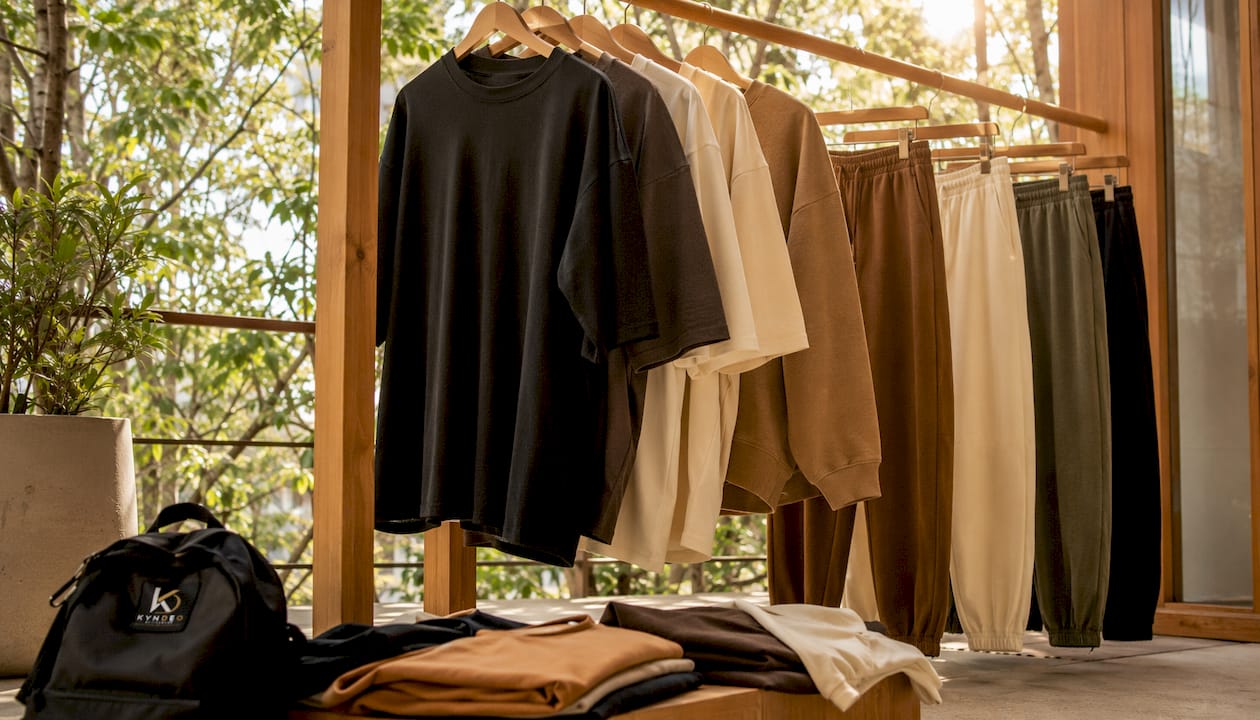
Coordinated matching sets simplify the gym-to-street equation entirely. One decision, one look, built for motion.
How to care for relaxed-fit activewear
Wash cold, use a gentle cycle, skip the dryer, and reshape while damp. That four-step rule preserves knit structure, stretch, and any technical finishes on most relaxed-fit pieces.
Care checklist:
- Wash in cold water (30°C / 86°F or below) to protect elastic fibers
- Use a gentle or delicates cycle to reduce mechanical stress on the knit
- Avoid fabric softener, which coats moisture-wicking fibers and reduces performance
- Air dry flat or hang to dry; never tumble dry on high heat
- Store folded, not hung, to prevent shoulder stretch on heavier knits
Always check the product tag first. Sustainable or specialty fiber blends (recycled nylon, bamboo-blend jerseys) sometimes require specific detergents or lower wash temperatures than standard synthetics. When the tag and general rules conflict, follow the tag.
Pro Tip: Turn garments inside out before washing to protect printed graphics and surface finishes.
Kyndeoactivewear brings relaxed-fit design to everyday movement
Kyndeoactivewear is a Black-owned activewear brand built for the gym-to-street lifestyle, where comfort and structure have to coexist. The collections cover relaxed-fit tees, hoodies, joggers, tanks, and coordinated matching workout sets designed to move from a morning session to the rest of your day without a wardrobe change.
Every piece is built around movement-ready fabrics and intentional design details: dropped shoulders, curved hems, and stretch-forward construction. The gym-to-street collection is specifically curated for this transition, and the women’s activewear and men’s collections are organized by activity type so you can find the right relaxed-fit piece without guessing. Sustainable fabric options are available for shoppers who want lower-impact choices without sacrificing performance.
Browse the collections and find your fit at Kyndeoactivewear.
Key Takeaways
Relaxed fit activewear is a versatile cut in an active wardrobe: engineered for movement, built for comfort, and styled for life beyond the gym.
| Point | Details |
|---|---|
| True relaxed fit is pattern-engineered | Extra ease is placed in the chest, waist, and hips; buying a larger size does not replicate this. |
| Best for low-to-medium intensity | Ideal for yoga, Pilates, travel, errands, and gym-to-street transitions. |
| Thermal comfort advantage | Loose fits improve airflow and heat dissipation during moderate activity compared to compression cuts. |
| Fabric determines performance | Moisture-wicking, four-way stretch knits keep relaxed pieces functional, not just comfortable. |
| Kyndeoactivewear | Offers gym-to-street relaxed-fit collections, matching sets, and sustainable options for everyday movement. |
Why relaxed fit deserves a permanent spot in your rotation
Most activewear conversations default to compression. More support, more performance, more muscle activation. That framing works for race day or max-effort lifts. It doesn’t work for the other 90% of your active life.
The research on thermoregulation is clear: looser fits improve airflow and reduce heat stress during moderate activity. That’s not a minor comfort perk. For anyone training in warm conditions, doing back-to-back studio classes, or simply moving through a full day, overheating is a real performance limiter. Relaxed fit addresses it structurally, not just stylistically.
What gets underestimated is how much the styling gap has closed. Structural details like ribbed necklines, curved hems, and coordinated matching sets mean relaxed-fit activewear no longer reads as “I gave up.” It reads as intentional. That shift matters for people who want their wardrobe to work across the whole day, not just inside the gym.
The right relaxed-fit piece, in the right fabric, styled with proportion in mind, is one of the most practical investments in an active wardrobe. Not because it’s trendy. Because it actually fits the pace of real life.
Useful sources
- The Role of Sports Clothing in Thermoregulation, Comfort, and Performance During Exercise in the Heat — PMC: Peer-reviewed narrative review covering how fit and fabric affect airflow, heat dissipation, and thermal comfort during exercise. Core source for the support-vs-thermoregulation trade-off.
- Performance vs Relaxed Fit: The Ultimate Sportswear Fitting Guide — Fitt Design: Industry guide explaining pattern-based differences between relaxed and performance fits, including sizing guidance and fabric recommendations.
- Sportswear Fit Types: Slim, Athletic & Relaxed Cuts — Bushi Sports: Practical breakdown of fit categories with activity-matching guidance and gym-to-street design context.
- What Does Relaxed Fit Mean? A Complete Style Guide — ProWearTrends: Styling-focused guide covering structural details (ribbed necklines, curved hems, tuck/tie techniques) that keep relaxed pieces polished.
- KYNDEO Activewear — Activewear for Life: Brand page outlining Kyndeoactivewear’s gym-to-street philosophy, collections, and sustainability commitments.
FAQ
What is relaxed fit activewear?
Relaxed fit activewear is clothing pattern-drafted with extra ease through the chest, waist, and hips for comfort and mobility, while keeping the shoulder seam aligned with your actual shoulder. It’s engineered for movement, not just sized up.
How does relaxed fit differ from compression activewear?
Relaxed fit prioritizes airflow, thermal comfort, and range of motion; compression fit prioritizes muscle support and reduced oscillation during high-impact activity. For yoga, Pilates, and gym-to-street wear, relaxed fit is the better choice.
Can relaxed-fit activewear handle real workouts?
Yes, when made from moisture-wicking, four-way stretch fabrics with seamless construction, relaxed-fit pieces support medium-impact activities effectively. High-intensity running or heavy lifting still benefits from compression.
How do I know if a relaxed-fit piece actually fits correctly?
The shoulder seam should sit at the edge of your shoulder, not drooping onto your arm. You should have room through the chest and hips without excess pooling, and the hem should cover your waistband when you reach overhead.
Where can I shop relaxed-fit activewear for gym-to-street wear?
Kyndeoactivewear offers a curated range of relaxed-fit tees, hoodies, joggers, and matching activewear sets designed for gym-to-street transitions, available for both women and men.